"Hand, hand-rolled hem, weight and colour-fastness: the concrete signals that separate silk woven in Como from generic silk, and how to use them before buying a scarf."
Faced with two silk scarves that look identical, the price can differ fivefold. Yet both are "100% silk": the label tells the truth about the fibre, but says nothing about where and how that fibre was woven, printed and finished. That is where the gap opens up between an accessory that lasts a lifetime and one that yellows after two washes. Telling Como silk apart from generic silk, often of Chinese origin, does not require a microscope: your hands, your eyes and a few minutes of attention are enough.
First, an honest note. Raw silk is reared and spun almost everywhere in Asia today, China included: the silkworm knows no borders. So the right question is not "where does the thread come from", but "who turned it into fabric and accessory". Como does not rear silkworms: Como is the district where yarn becomes real silk, through weaving, printing and finishing of the highest precision. It is the difference between flour and bread.
The hand: the first test, and the most reliable
"Hand" is the technical term for what you feel when you squeeze the fabric in your palm. Silk woven in Como has a full but fluid hand: it weighs just right, slips between the fingers without friction, and springs back when you release it. Generic silk often errs in two opposite directions. Either it is too thin and "rubbery", with a slightly plasticky surface that is the sign of chemical finishes used to fake a body the fabric lacks. Or it is stiff and papery, because the finishing was skipped to save money. Scrunch a corner in your fist for three seconds and release: good silk relaxes almost immediately, poor silk stays marked by creases.
The hand-rolled hem: where the real cost hides
The most telling detail is the edge. A quality foulard has a hand-rolled, hand-sewn hem, the so-called "roulotté": the fabric is folded back on itself into a thin, soft cord, fixed with invisible stitches. It takes minutes of handwork per side, and that is why it costs. Turn the edge to the light: if you see a small, regular roll and a seam invisible from the front, it is handmade. If instead the edge is flat, machine-cut and held by a straight, visible stitch (the "machine" hem or, worse, heat-sealed, which leaves a shiny, hard rim), the maker cut corners exactly where they shouldn't. The hand-rolled hem is the hardest signature to imitate.
Print, colour and how it lasts
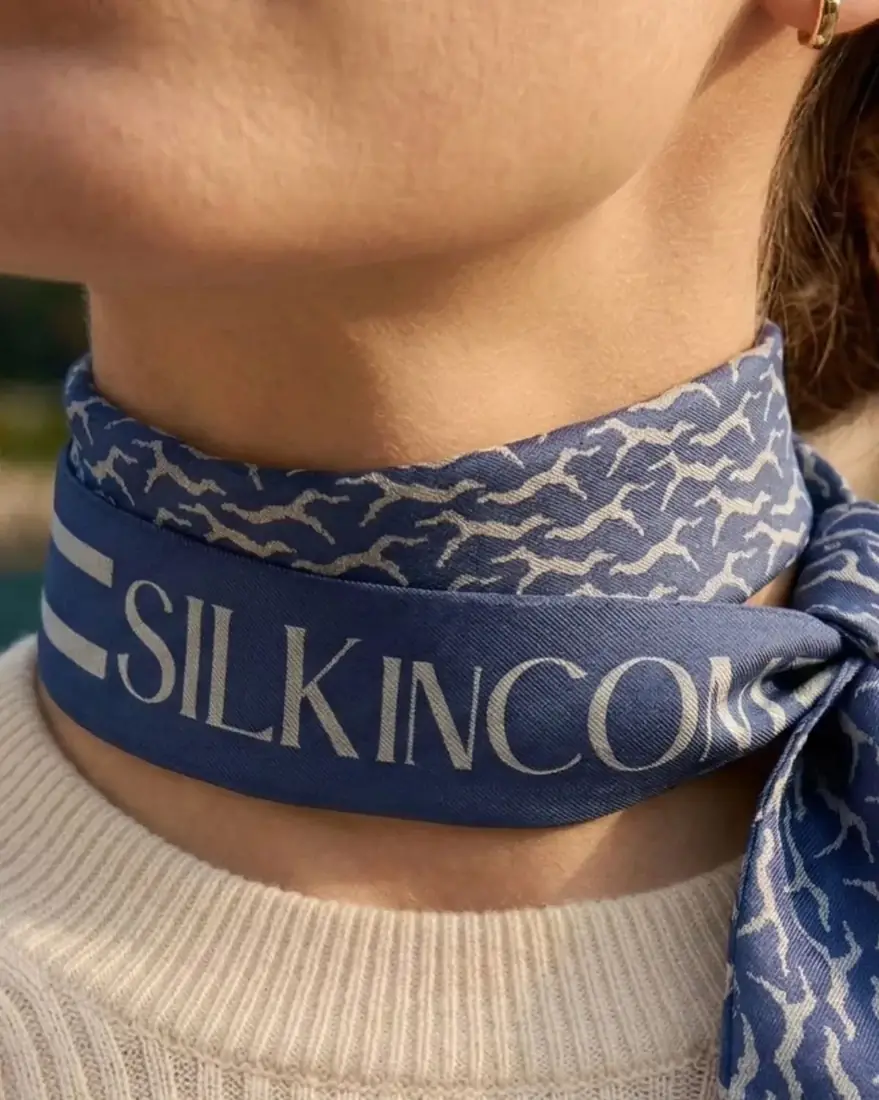
Open the foulard and look at the reverse. On a well-made print, the design shows through with almost the same intensity as the front: it means the colour penetrated the fibre. On a cheap print the reverse is faded, milky, and the outlines of the motifs are blurred or "out of register" (the colours do not line up). Look also at the finest lines and small lettering: Como silk holds definition even at tiny scales, because the fabric is dense and uniform. Finally, living colour: badly finished silk loses tone at the first wash or yellows with perspiration. Silk finished properly keeps depth and brilliance for years.