Customer careCashmere pashminas for luxury hotels | SILKinCOM
Journal • September 18, 2026
The pashmina guests don't leave in the room: the new gesture of Lake Como's luxury hotels
di—Fondatore SILKinCOM
"Slippers, bath kits, chocolates: almost everything stays in the room. A cashmere pashmina doesn't. Why Lake Como's hotels are turning the evening shawl into the gift guests take home."
Every luxury hotel knows two moments of truth. The first is check-in, when the guest decides within thirty seconds whether the price was justified. The second is the suitcase at check-out: there, with no rhetoric and no satisfaction questionnaires, you see what the property actually left behind. Slippers, shower cap, bath kit, the chocolate on the pillow: almost everything stays in the room. Something else, though, leaves with the guest and keeps speaking about the property for years.
That something is hospitality's real souvenir. And the best souvenir is not bought in the souvenir shop.
The amenity has a memory problem, not a quality problem
A five-star property's amenity budget is spent almost entirely on consumables. They are often excellent: creams from serious perfumers, selected teas, fresh pastry. The flaw is not quality, it is lifespan. An object that runs out at the end of the stay has a useful life identical to the stay itself: the investment and the memory end together, at the same hour.
A cashmere pashmina reverses the equation. It is not consumed: it is worn. It goes home with the guest, enters the wardrobe, is packed again for other journeys, gets noticed and asked about. Every time someone asks "where did you get it?", the answer contains the hotel's name. It is the only form of advertising a guest is glad to do, free of charge, for years.
The problem every manager knows: nine in the evening, on the terrace
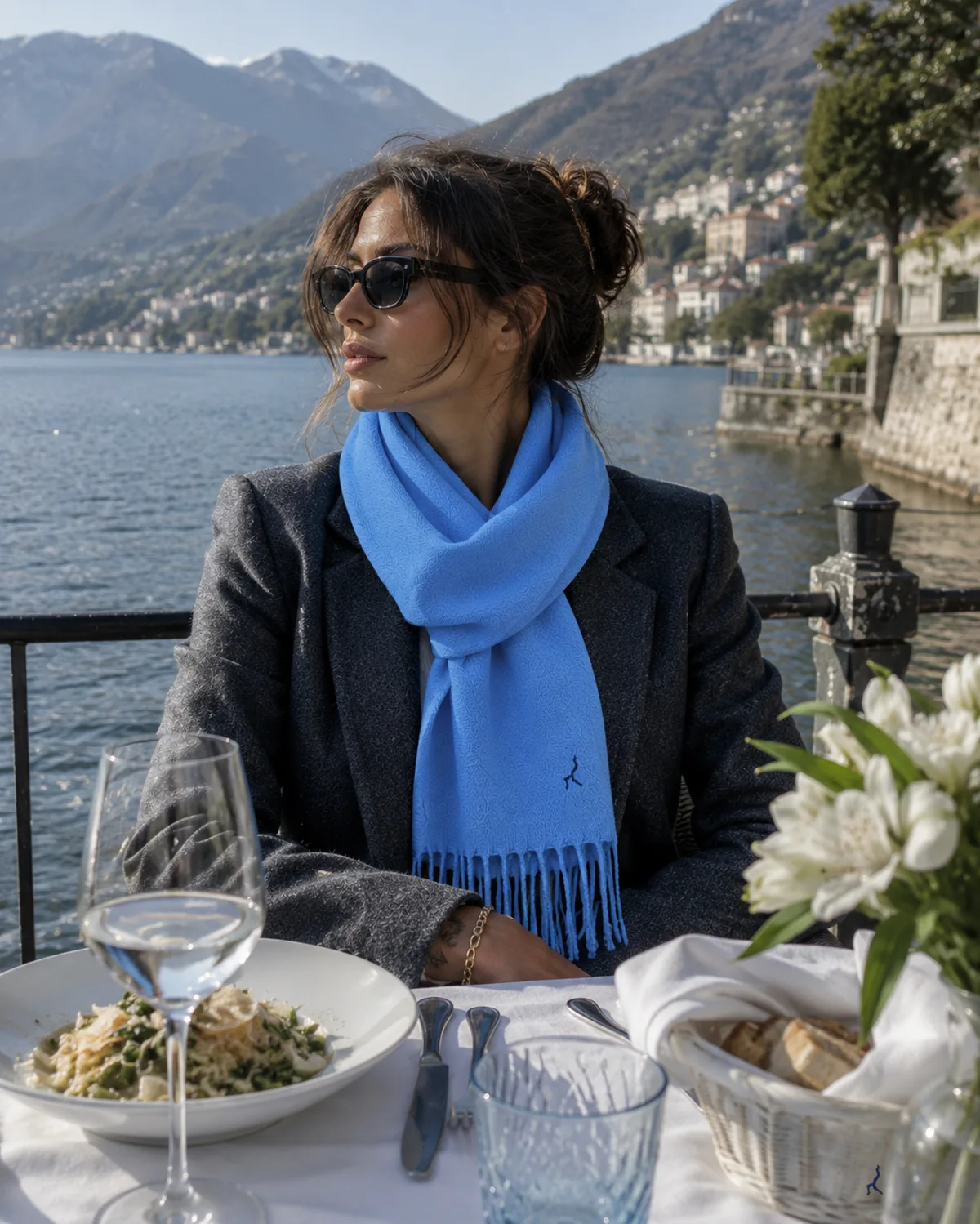
Evenings on the lake are cooler than the forecast suggests. The air comes down from the mountains, the humidity rises off the water, and at nine o'clock, without fail, someone asks for a shawl. This is the moment most properties answer with a service throw washed a thousand times, often acrylic, often in the same shade as another throw that was in the lounge last week.
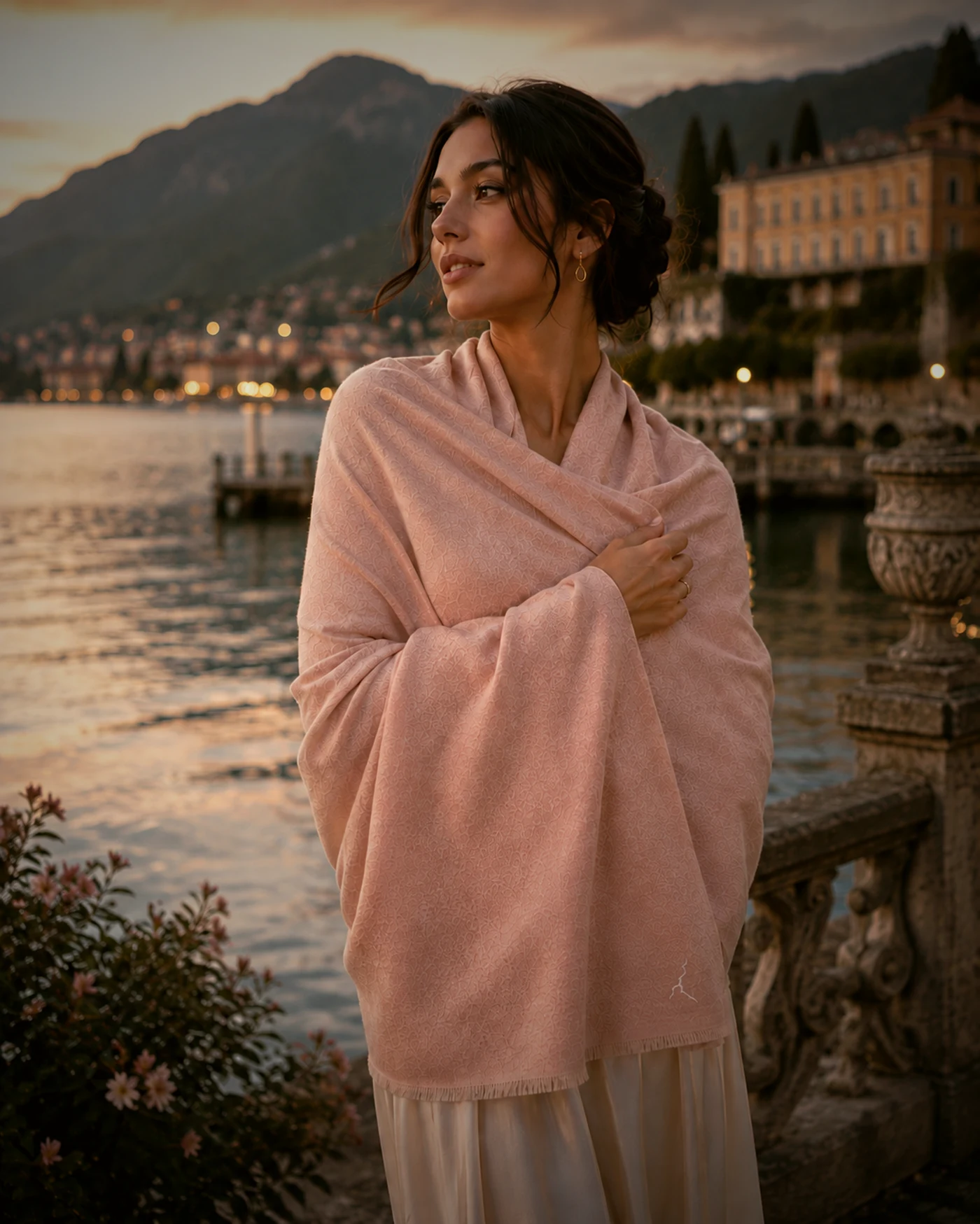
It is a wasted opportunity, because that moment is the most emotional of the day: sunset, dinner, conversation, photographs. Offering a pure cashmere pashmina at that instant is not a service detail — it is the scene the guest will describe once home.
Why cashmere and not a "cashmere blend"
The difference is not ideological, it is tactile and immediate. Pure cashmere warms without weight, folds into a small bag, and above all avoids that dry surface feel that gives acrylic away instantly. A guest used to luxury understands it on first contact, before even reading the label.
Continue reading
That is why, the moment a property decides to use a textile accessory as a gesture towards its guests, composition becomes the single most important choice: 100% cashmere, not blends disguised behind generic wording such as "cashmere touch" or "cashmere feel". A gift that looks valuable but is not produces the opposite effect to the one intended, and produces it fast.
The second indicator is the finish. The hem and the fringe are where the hand shows: a hand-finished edge holds its folds and its years, a heat-sealed one begins to fray by the third wash. If you need a quick yardstick, we have gathered the practical checks in our guide on how to recognise a real cashmere pashmina.
Three sizes, and the three different uses they cover
The Bellagio Cipria pashmina comes in three formats, and it is useful to think of them as three distinct products, because they solve three different moments in a guest's day.
180 x 45 cm — the evening scarf
The lightest format, at 120 euros. It is the gesture laid on the bed during turndown, or carried out to the terrace by the concierge: it covers the shoulders, knots at the neck, asks nothing. It is also the easiest size to give, because it requires guessing nothing about the guest.
180 x 70 cm — the true shawl
At 180 euros, this is the format that genuinely wraps. It is the choice for dinner outdoors, for a boat crossing at sunset, for guests who stay out late. If the property has a terrace or a jetty, this is the size you need.
140 x 140 cm — the square ceremonial stole
At 270 euros, this is the event format: weddings, galas, formal dinners. Draped over the shoulders above a long dress, it holds its own against outerwear. It is also the piece a property can keep in a limited number of examples, reserving it for its most important guests.
The logo is embroidered and available in three colours — white, burgundy, brown — a useful detail for anyone wanting to distinguish a room from a suite without changing product.
Powder pink is an operational choice, not an aesthetic one
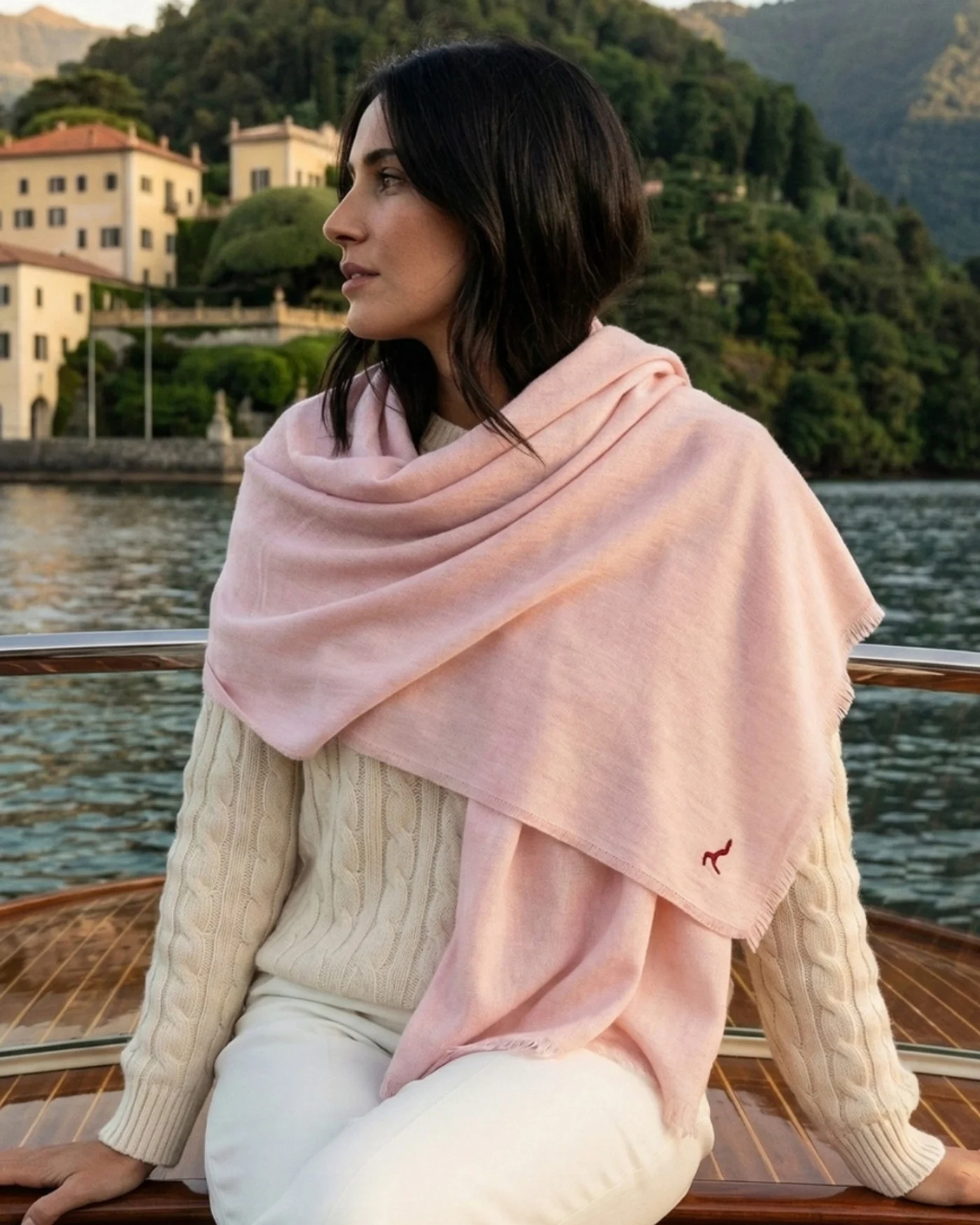
Powder pink looks like a matter of taste. In practice, for a property, it is the most workable choice: a warm neutral that flatters every complexion, quarrels with no dress code, and does not clash with a wedding guest's outfit the way a strong red or blue would.
There is a second, less obvious reason: it photographs well. On the lake, in sunset light, powder pink takes on the same temperature as the light and never dulls the skin. Whoever wears it at that hour tends to be photographed, and every published photograph is content that talks about your terrace without costing you a euro in advertising.
Four concrete ways to use it in the property
The evening gesture, on the terrace and the jetty
A basket of pashminas at the entrance to the terrace, offered as the light fades. This is the entry level, and it needs no amenity budget: the pashminas remain the property's and go back into service.
Welcome for suites, anniversaries and returning guests
Folded on the bed with a handwritten card, a cashmere pashmina replaces three consumable amenities and costs less than a complimentary dinner for two. It works better arriving not on the first evening but on the second or third: the guest has already decided they are comfortable, and the gift becomes a confirmation rather than a routine welcome.
Weddings and events on the lake
Here the arithmetic changes scale. Fifty guests wearing the same powder-pink pashmina during a sunset reception are, at once, a service to the guest, a piece of staging and fifty photographs circulating for weeks. It can be built straight into the wedding package, with the couple's monogram in place of the logo.
The boutique that takes up no space
Not every pashmina has to be free. A discreet display at reception, or a card in the room with a QR code to the selection, turns the same product into ancillary revenue, with margin and without stock. For many properties this is the most sensible way to begin: you measure the guests' reaction before committing the amenity budget.
Lent or given: two different models, both valid
It is worth keeping the two levels distinct, because their economics differ.
A pashmina that is lent is a service. It costs once, comes back, is washed, lasts seasons. It improves the evening and the perception of the property, but it stays inside the hotel: it does not travel, and it generates no story outside.
A pashmina that is given is a memory. It costs for every guest, but it leaves the property and keeps working for years. With cashmere there is a further effect: the guest knows what it is worth, so they will never throw it away or bury it at the back of a drawer.
The soundest strategy is to keep both: the service on the terrace for everyone, the gift for long stays, suites, anniversaries and returning guests.
Personalise without distorting
Personalisation works when it stays discreet. A monogram embroidered in one corner, thread chosen in the brand's colour, wrapping in the property's own paper and ribbon: the guest recognises the hotel but wears an accessory, not a uniform. A large centred logo is the fastest way to send a beautiful piece to the back of a drawer.
The SILKinCOM B2B programme works on three levels: catalogue selection with reserved terms, personalisation with a monogram or dedicated embroidery, and white-label capsules built entirely around the property's identity. The minimum is 20 pieces, lead times run from four to eight weeks depending on complexity, and we answer every enquiry within 24 hours with a dedicated price list.
Care: what housekeeping needs to know
If the pashminas stay in service, maintenance decides how long they last. Cashmere is washed by hand in cold water with a neutral detergent, never wrung: blot it in a towel and dry it flat, away from heat sources. It must not be hung, because the weight of the water distorts the weave.
Out of season it is stored folded, never on a hanger, in a cotton bag: plastic traps humidity and cashmere needs to breathe. A cashmere brush solves the natural pilling of the first few weeks, which is not a defect but the normal behaviour of a real fibre. The full instructions are on our product care page.
The arithmetic works
A centrepiece lasts one evening. A sponsored campaign lasts as long as the budget. A cashmere pashmina stays in the wardrobe for years, and for all those years it keeps producing the one thing a hotel cannot buy on a performance basis: the spontaneous account of a satisfied guest, in front of people who resemble them and can afford the same room.
For a high-end property, the calculation is simpler than it looks: what is a five-star review written on impulse worth? And what is a guest worth who, every time they put that pashmina over their shoulders, says your hotel's name?
The questions managers ask us
What is the minimum order?
Twenty pieces, which may be mixed across sizes and products. It is a threshold designed for boutique hotels, not for chains.
How long does it take?
Four to eight weeks for full personalisation. For catalogue selection without embroidery, lead times are far shorter: write to us with the date of the event and we will build the calendar backwards from it.
Can we use the hotel's logo?
Yes, as embroidery, replacing ours or alongside it. We always recommend the smallest possible version: it increases the number of times the piece will actually be worn.
Is it better to give it or keep it in service?
It depends on the type of stay. For one night, the terrace service is more than enough. For long stays, suites, anniversaries and returning guests, the gift is the best cost-to-memory investment we know.
Does it work for a twelve-room property?
Often it works better. A boutique hotel can afford a gesture a chain has to standardise, and the effect on the guest is exactly proportional to how personally intended the gesture feels.
Why a pashmina from Como rather than any supplier?
Because on Lake Como the product and the place coincide. Como has been Europe's capital of silk and high-end textiles for centuries: an accessory born here is authentically local without being a souvenir. For a lakeside property it is the rare case where the most elegant gift is also the most coherent with the setting.
Where to start
There is no coming back from the wrong product: a mediocre amenity leaves a mediocre memory. The quickest way to know whether this route suits your property is to handle the pieces. Send us an enquiry through the Hospitality & Corporate Gifting programme stating sizes, indicative quantities and timings: we reply within 24 hours with a reserved price list and, where it makes sense, with samples. Anyone preferring to start from the catalogue can meanwhile see the full selection of cashmere pashminas.
Then let the guest do the rest. Because in the end luxury hospitality is not measured in stars: it is measured by what someone decides to put in their suitcase.